

Next-Generation Multiplexed GPCR Screening
Powered by proprietary ultrasensitive bioluminescent reporter and assay technologies
Next-generation multiplexed reporter systems designed to simultaneously monitor GPCR signaling, pathway activation, reporter expression, and cell-health parameters from a single screening well.

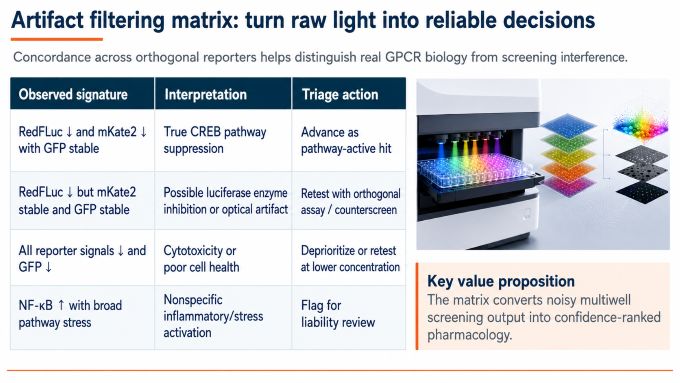
Built-in orthogonal reporter systems help distinguish true pathway biology from cytotoxicity, nonspecific activation, luciferase inhibition, and other common screening artifacts.
Enhanced Luciferase Reporters for Drug Discovery and HTS
Targeting Systems is developing a modular reporter and cell-line engineering platform for next-generation functional GPCR screening, drug discovery, and high-throughput screening (HTS). The platform combines proprietary bioluminescent reporters, pathway-responsive constructs, packaged lentiviral reporter tools, and multiplex-compatible assay reagents.
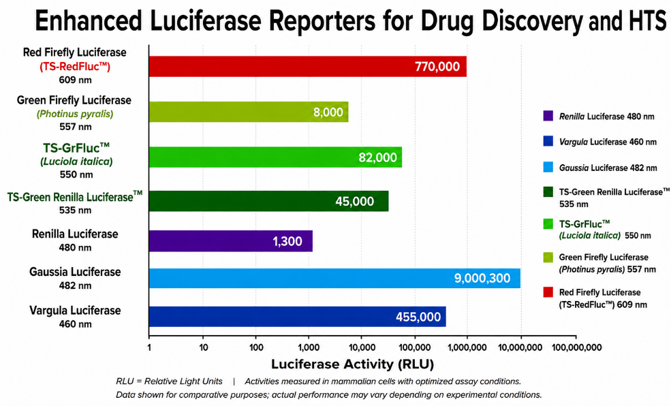 FIGURE 1:
Enhanced Luciferase
Reporters for Drug Discovery. Activities measured in HEK-293 cells under optimized assay
conditions.
FIGURE 1:
Enhanced Luciferase
Reporters for Drug Discovery. Activities measured in HEK-293 cells under optimized assay
conditions.
Our Reporters
- Enhanced TS-RedFluc™ (Red-emitting firefly luciferase, 10X brighter mutant).
- TS-GrFluc™ - Enhanced green-emitting firefly luciferase from Luciola Italica
- TS-Green Renilla Luciferase™ (GrRenLuc) - (35X brighter mutant).
- Secreted Gaussia luciferase (Gluc) - (20X brighter signal by modifying assay Chemistry).
- Secreted Cypridina (Vargula) luciferase (CypLuc).
- Multiplex-compatible reporter combinations (Spectrally resolved and Stop and Glow formats available)
- Fluorescence/bioluminescence fusion reporters with far-red-emitting RFPs minimize artifacts, allow correction for cell number
Platform Capabilities
- Simultaneous monitoring of multiple signaling pathways
- NFAT pathway activation
- NF-κB pathway and stress-response monitoring
- CREB / cAMP signaling analysis
- Reporter protein accumulation and expression tracking
- Cell-health and viability normalization
- Built-in artifact filtering and hit triage
- HTS-compatible assay workflows
- Multiplexed bioluminescent assay formats
Applications
- Functional GPCR screening
- Biased agonism profiling
- Agonist and antagonist characterization
- Peptide and small-molecule hit triage
- Orthogonal validation> of screening hits
- Drug discovery assay development
- Inflammatory pathway analysis
- Reporter cell-line engineering
- HTS workflow optimization
- Reporter cell-line development
Functional GPCR Screening Beyond Binding
GPCR binding does not always predict functional pharmacology. A compound or peptide may bind a receptor but act as an agonist, antagonist, partial agonist, biased ligand, or nonspecific stress inducer. Targeting Systems’ next-generation assay architecture is designed to help answer the critical downstream question.
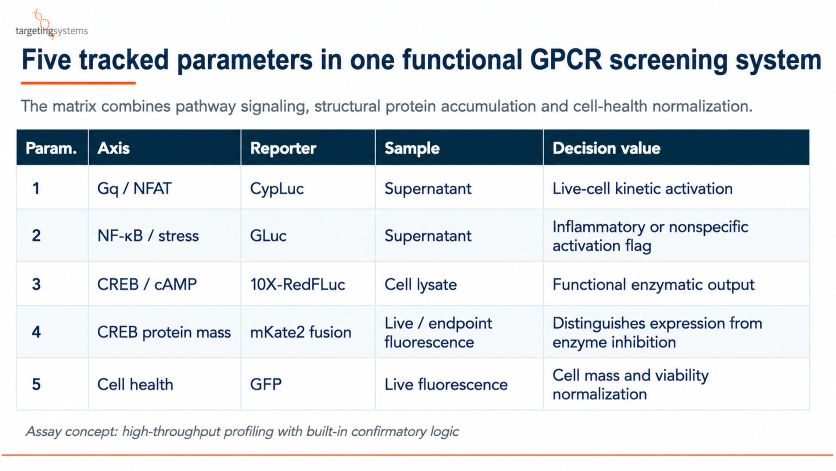
5-Parameter Functional Screening Matrix
A representative multiplexed GPCR screening format can integrate pathway activity, secreted reporter kinetics, endpoint reporter activity, protein-level confirmation, and cell-health normalization. This can generate five independent decision signals from a single well while preserving flexibility for custom pathway and reporter combinations.
Built-In Artifact Filtering
High-throughput screening campaigns can generate false positives and false negatives from cytotoxic compounds, optical interference, luciferase inhibition, nonspecific pathway stress, and variable cell density. The multiplexed assay matrix is designed to identify these issues earlier by comparing concordance across orthogonal readouts.
Custom Functional Screening Systems
Targeting Systems has developed a growing portfolio of reporter constructs, prepackaged lentiviruses, and detection reagents that can be assembled into custom functional screening systems. The portfolio supports both constitutive reporter cell-line generation and pathway-responsive assay development.
Prepackaged Lentiviral Reporters for Constitutive Expression
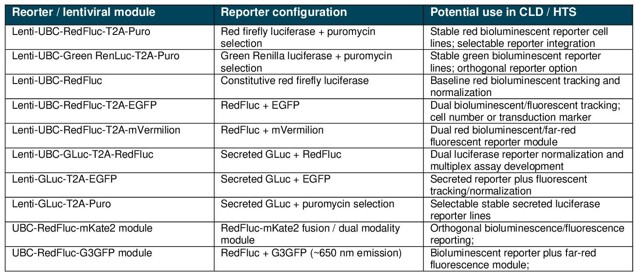
A panel of versatile prepackaged lentiviruses are available as constitutively expressed reporter modules for generation of stable reporter cell lines, cell tracking, viability/normalization controls, and assay-development workflows.
Options include RedFluc-Puromycin (or co-expression of RedFluc with far-red RFPs emitting between 633-650 nm), GrRenLuc-Puromycin expression, and Gluc-Puromycin or Gluc-Blasticidin (or co-expression with EGFP or RFPs).
Table 1: Constitutive luciferase reporters driven by UBC promoter or dual bioluminescent/fluorescent reporter lentivirus and potential uses
Pathway-Responsive Reporter Modules
Targeting Systems has also developed pathway-responsive reporter modules covering major signaling axes relevant to GPCR pharmacology and screening artifact analysis. These modules provide a foundation for custom multiplexed GPCR assays and reporter cell lines.
Table 2: Pathway / trigger responsive reporter modules
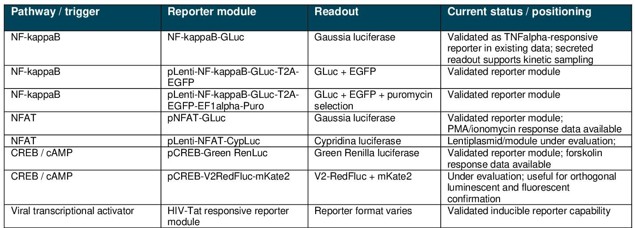
Reporter modules include validated NF-kappaB, NFAT, and CREB/cAMP-responsive formats, with selected modules being advanced into lentiviral configurations for rapid stable cell-line generation.
RedFluc-GLuc Dual Assay Architecture
Targeting Systems has developed a proprietary add-and-read dual-luciferase detection reagent capable of measuring and spectrally resolving compatible luciferase reporters within a single assay workflow. This format supports simplified multiplexed detection, reduced handling steps, internal control normalization, and HTS-compatible screening formats.
- • Single-solution add-and-read format
- • No wash or transfer steps
- • Compatible with spectrally resolved luciferase readouts
- • Supports internal control normalization
- • Previously utilized in high-throughput screening applications
- • Can be paired with fluorescent normalization modules for an additional cell-number or viability readout
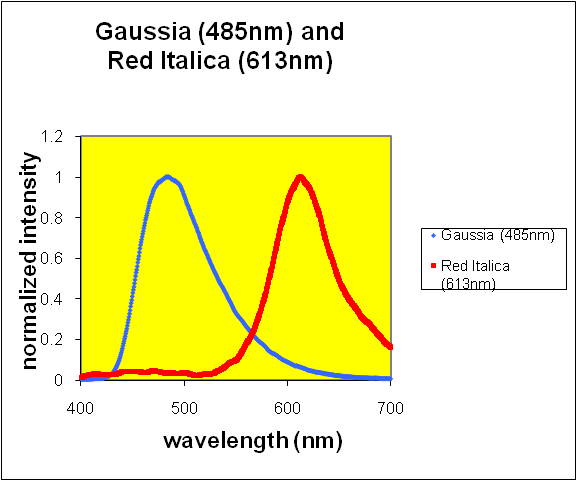
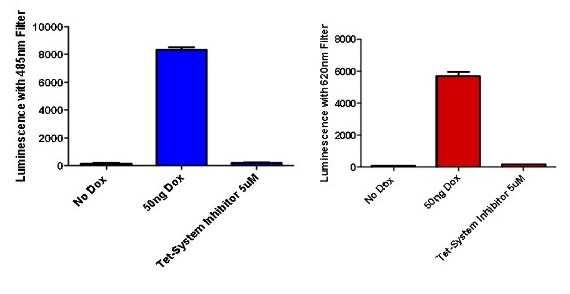
FIGURE 2: Panel A -Single-solution dual-luciferase spectral resolution: Spectral profiles of TS-RedFluc and Gaussia luciferase. Panel B - Chemical screening for DUX4 inhibitors in 293T-iDUX-GR cells: Tet-inducible inhibitor (a false positive compound discovered in a previous screen) blocks both DUX 4 receptor-Gaussia luciferase expression and TRE-Red Italica Luciferase (RedFLuc) expression (Data courtesy of Dr Erik Toso, Si Ho Choi, and Dr Michael Kyba, University of Minnesota, USA).
Proof-of-Function Reporter Activation
Targeting Systems has generated proof-of-function data demonstrating inducible activation across multiple pathway-responsive reporter systems. The most relevant public-facing proof points for GPCR screening are NF-kappaB, NFAT, and CREB/cAMP reporter activation.
- • TNFalpha-induced NF-kappaB activation: Monitored continuously using secreted Gaussia luciferase.
- • PMA/ionomycin-induced NFAT: Validated reporter activation profiles.
- • Forskolin-induced CREB / cAMP: High-sensitivity signaling pathway resolution.
- • Multiplex Engineering: Enhanced red, green, and secreted luciferases supporting multi-channel assay matrices.
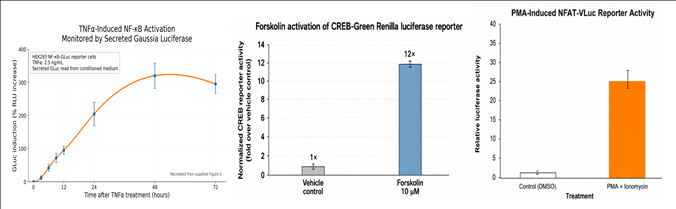
FIGURE 3: Representative pathway-responsive reporter data demonstrate inducible
NF-kappaB, CREB/cAMP, and NFAT activation using TNFalpha, forskolin, and PMA/ionomycin
stimulation, respectively in HEK-293 cells
Panel A: NF-kappa B-Gluc activation kinetics in response to stimulation
by 2.5 ng/ml TNFalpha.
Panel B: CREB-Green Renilla activation, NFAT reporter activation in
HEK-293 cells.
Additional Multiplex Assay Format: Cypridina–Gaussia Dual Luciferase Detection
Targeting Systems has developed an UltraBrite™ Cypridina–Gaussia dual luciferase assay reagent designed for the sequential detection of secreted Cypridina luciferase (CypLuc) and Gaussia luciferase extracted from the exact same sample destination.
Because both diagnostic reporters are natively secreted, this platform enables non-destructive kinetic monitoring, automated repeated sampling routines from identical cell populations, and HTS-compatible continuous path analysis. Additionally, Cypridina luciferase features high room-temperature stability, offering extreme structural flexibility during automated fluidics handing pipelines.
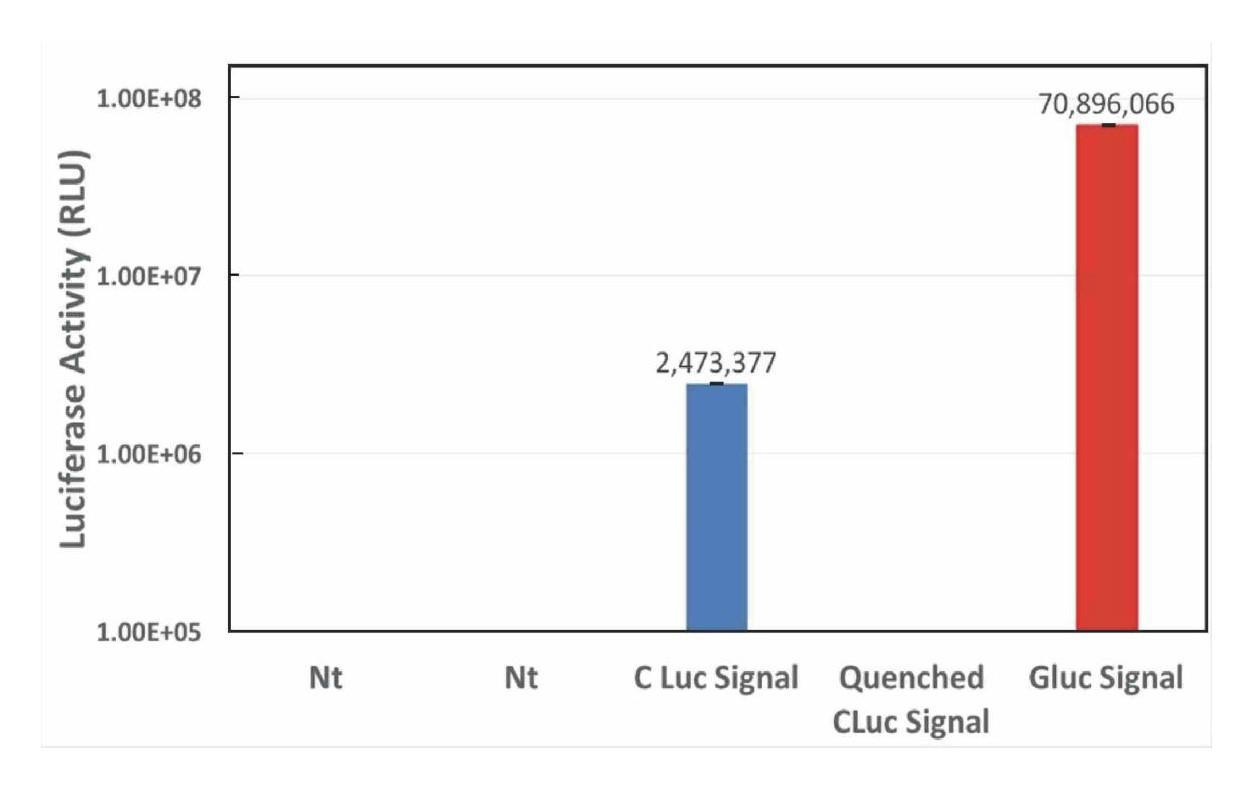
FIGURE 4: Sequential detection of CLuc and GLuc in cell supernatants using the Ultrabrite TM Cypridina-Gaussia Dual Luciferase Assay reagent (TS Catalog #DLAR-4SG-1000) Aliquots of medium (10 µL) from transfected HEK293 cells were assayed with 50 µL of VLAR reagent to measure CypLuc activity. After 2 min 50 µL of the working GLuc assay component (GAR Quench & GlowTM Reagent) was added to quench CypLuc activity and enable measurement of GLuc activity. Nt refers to non-transfected (control) cells assayed with either the CLAR (left) or GAR Quench & GlowTM (right) reagent; Data shown is means ± SD (n = 5).
Ultrasensitive Single-Luciferase Add-and-Read (ANR) Reagents
For standalone pathway validation tiers, Targeting Systems supplies highly stable single-luciferase evaluation reagents built completely around a streamlined Add-and-Read (ANR) process layout.
UltraBrite™ Gaussia Luciferase Assay Reagent (GAR-ULTRA)
Engineered explicitly for automated HTS configurations where strong signal metrics, speed, and long-term stability are mandatory parameters. GAR-ULTRA exhibits a 20X brighter bioluminescent signal output alongside an elevated signal-to-noise ratio profile compared to standard commercial alternatives when targeting the standard GLuc double mutant (M2).
This ultra-high raw performance tier makes the assay optimized for tracking low-copy integration cells or weak promoter elements. When evaluated alongside native wild-type GLuc reporters, total analytical performance metrics register at 10X higher sensitivity thresholds compared to historical GAR-2 or alternative commercial assays.
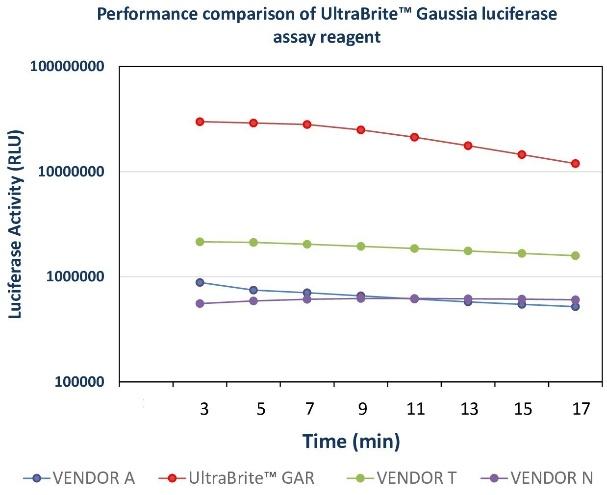
FIGURE 5: Comparative signal generation kinetics mapping UltraBrite™ GAR-ULTRA performance profiles against industry standard assay options.
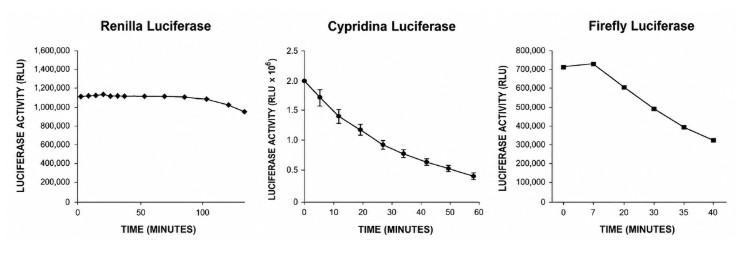
FIGURE 6: Long-term bioluminescence signal stability tracking windows inside Firefly, Renilla, and Cypridina Luciferase custom reaction steps.
Drug Discovery & Technology Frameworks
Information on selected prepackaged lentiviral reporter products and cell-tracking technologies can be found at: https://targetingsystems.net/cell-tracking.php
Additional proprietary luciferase–fluorescent fusion reporters and stem-cell lineage-tracking lentiviral systems are available upon request.
Deep-tissue imaging data shown elsewhere were generated using the original TS-RedFluc platform; V2 and Fusion architectures are currently under evaluation.
Partnership Opportunities
Targeting Systems welcomes discussions regarding custom reporter cell lines, multiplexed GPCR assay development, sponsored feasibility studies, technology licensing, and strategic collaborations.